The Image Model That Plans Before It Draws
Canva Craft doesn't guess pixels the way other image models do. It writes a composition plan first and renders second — because it learned to plan from millions of human-made templates. That is the most honest answer yet to the question of what an image generator is actually for.
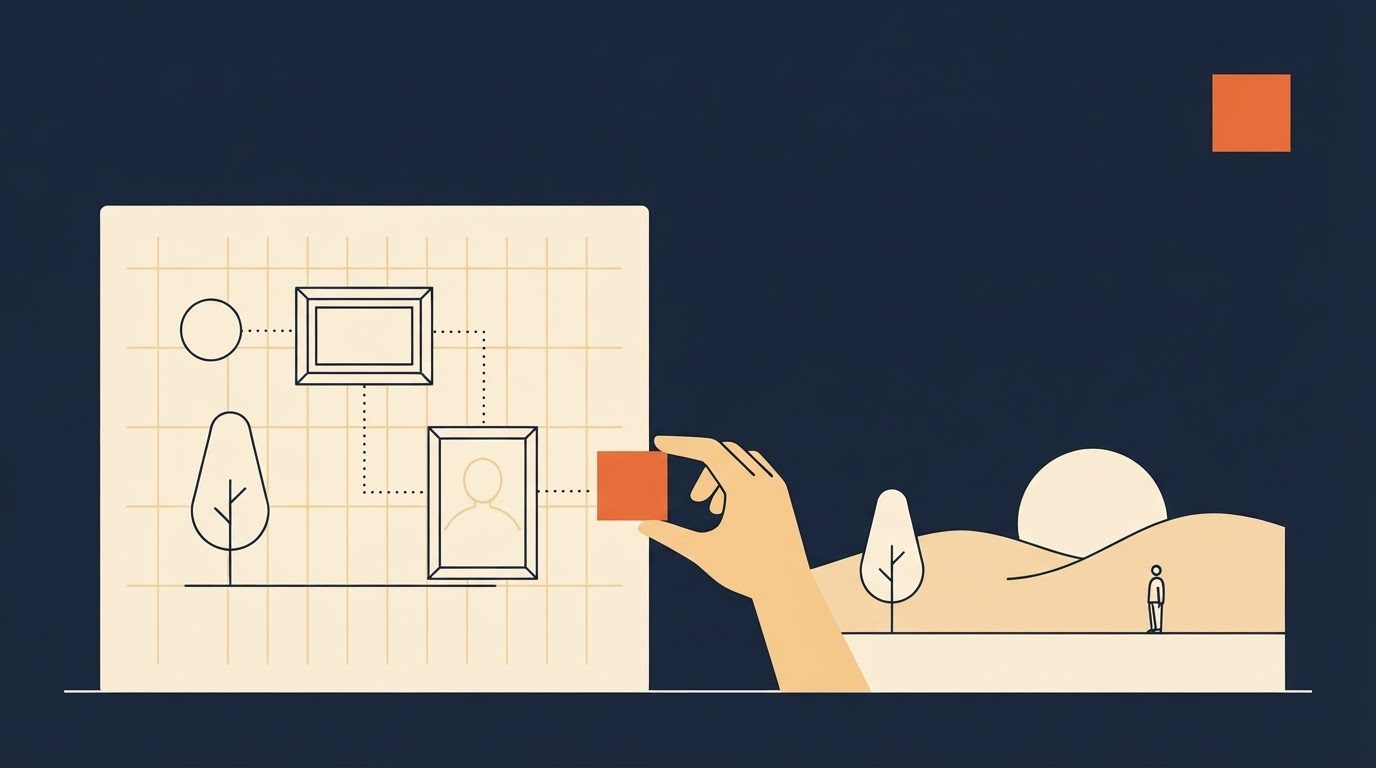
On 22 October, Canva — the tool more than a quarter of a billion people use to make things look designed — shipped its first image generation model. Most of the coverage of the launch was about rankings and resolution, and that missed the point. The sentence worth slowing down on is the one describing how the model works. Canva Craft, as it is called, writes a plan of the image before it draws anything: which elements appear, where they sit in relation to each other, their relative scale, the visual hierarchy, and the text that has to be in the picture. Only then does a second stage render the pixels. Every image generator before it went straight from prompt to pixels and hoped. Craft decides first and draws second, and that difference is the actual news.
It is a genuinely different architecture, and it is worth being precise about why it matters, because it is easy to read "plans before it draws" as a marketing phrase. It is not. Conventional image models treat an image as one thing to predict, pixel by pixel, and the classic failures follow from that: text comes out garbled, objects land where nothing would put them, and the result is a finished picture you cannot change. Craft's two stages separate the decisions from the drawing. The planning stage — a model trained on composition — interprets the prompt and writes a structured description of the image. The rendering stage then fills that structure in at up to 2K resolution, in more than thirty aspect ratios, with text set in fifty-five languages.
Canva says more than a quarter of a billion people use the platform, creating over 400 designs every second, and that Craft was trained on millions of human-made templates from its own library — posters, social posts, presentations, infographics, menus and typography-heavy layouts — rather than on photographs, so the model learns how layout, hierarchy and typography fit together.
Source: Canva newsroom, "Introducing Canva Craft" (22 October 2026)
The second failure the architecture fixes is the one that kept AI images out of real design work: they could not be edited. A generated picture was a dead end. You could not move the headline, swap the product shot or change the hierarchy, because there were no layers. Craft's plan doubles as a layer structure. Canva's Magic Layers feature can turn a generated image back into a layered document you can pull apart, and the company is uncharacteristically blunt about why that matters: flat, fixed images, it says, are a creative dead end.
The rankings, for what they are worth, put Craft fourth on DesignArena, a crowdsourced leaderboard where people vote on generated images head to head. It sits behind three OpenAI models — GPT-Image-2.5 Sunburst, GPT-Image-2.5 Flare and GPT Image 2. Being honest about that matters, and so does one detail: Craft's position rests on roughly two thousand head-to-head battles, while the models above it have been judged tens of thousands of times. The ranking is real and early.
On DesignArena's image leaderboard (updated 24 October 2026), Canva Craft ranks fourth with an Elo of 1330, behind GPT-Image-2.5 Sunburst (1408), GPT-Image-2.5 Flare (1383) and GPT Image 2 (1363). Craft's rating is based on 2,086 head-to-head battles, compared with more than 11,000 for the model in first place.
Source: DesignArena image leaderboard (accessed 24 October 2026)
When automated evaluations and human judgments differed, we sided with the designer.
— Canva, "Introducing Canva Craft" (22 October 2026)
Now the part of the story that deserves more attention than it got. The model learned to plan from humans. Most image models are trained on photographs; Craft was trained, in large part, on millions of human-made templates from Canva's own library — the posters, presentations and menus that people actually designed with the tool. A template is a finished decision: someone chose the hierarchy, the spacing, the emphasis. Trained on enough of those decisions, the planning stage is effectively a compressed archive of how millions of people solved the same problem. The machine that now proposes compositions is replaying the judgement of the people who did the planning first. That is not an accusation; it is how the whole industry works. But it is worth noticing that the most mainstream design tool on earth just automated the part of design its own users did most, and did it with their work as the curriculum.
The other thing the launch coverage mostly skipped is why Canva built this at all. A design app does not normally train a foundation model from scratch. The answer is that Canva was paying the model labs to power its own product, and the bill was hurting. Its chief executive, Melanie Perkins, told shareholders the company was "relying too heavily on frontier models" and that the "average cost of serving an AI task was too high". Canva cut its forecast revenue growth from 30 to 20 per cent while it rebuilt.
We decided to slow the rollout while we rebuilt the architecture, reduced unit costs and strengthened the business model.
Canva's valuation peaked at US$42 billion in 2025. In August 2026 its earliest backers Blackbird and Airtree had external valuers mark the company down 17 per cent to US$34.9 billion, and a secondary-market broker was offering Canva stock at an implied valuation of about US$30 billion. Investor Jason Lemkin told the 20VC podcast that AI was "maiming" the business and that agents had "just routed us around Canva".
Source: SmartCompany, "Canva just wiped another $11 billion from its valuation" (18 August 2026)
Craft is the answer to that too. Own the model, and the economics flip: Blackbird's Rick Baker says Canva has brought the cost of serving AI down 90 per cent. The model that plans first is, among other things, the cheapest way Canva has found to stop paying its competitors and keep its users inside the product. That is a survival story as much as an innovation one, and it is worth holding both in mind.
This is the point where a purely admiring account would stop, and the essay would be worse for it. A plan is a guess about intent. Craft can propose a composition that looks like a design — it has seen millions — but it cannot know what a particular design is for: the argument it makes, the brand it protects, the person it is aimed at. Its plan is the statistical centre of its templates, and the reason a specific design works is almost never that it is the average of other designs. The limit is not quality. It is that a machine can plan what a design should be and still not know why it should be that. Canva knows this, and it has built the product around the admission.
A truly useful AI system for design shouldn't simply generate a finished result and hope it's what someone had in mind. It should create a truly collaborative experience, where the final result can be as unique as the person behind it.
— Stef Corazza, Head of AI Research at Canva, "Introducing Canva Research" (21 October 2026)
The strongest objection is that this is a company telling its own story. "The world's second most advanced AI lab for image generation" is Canva's framing, drawn from a leaderboard it does not control but benefits from. Craft is fourth, behind three OpenAI models, on a sample of a couple of thousand votes. And the true driver of the project was probably cost, not craft — the economics forced the build, and the planning architecture is as much about cheap inference as about design. All of that is fair. None of it changes what the launch signals about the field. Image generation has spent three years chasing realism; the next argument is about decisions — who decides what belongs where, and whether anyone can change it afterwards. The clearest mainstream version of that argument just shipped, and it came from the design company, not the research lab.
For anyone using AI image tools, the shift worth watching is from "generate a finished image" to "generate a plan you can take apart". We review these tools for a living, and the question we now ask every one of them is not whether it can draw — they all can — but whether its output is editable, whether the human can get back inside the result and change the decisions. Prompt-to-editable beats prompt-to-finished, and Canva is the first big platform built around that distinction. The second question, the one nobody has answered, is what happens when the machine's education is your work — when the model learned to plan from the very designs it now proposes. That question was always coming. Canva's is just the largest library of human design decisions anyone has yet turned into training data.
Every image generator before Craft went from prompt to pixels and hoped. Craft plans first, and the reason it can is that humans planned first — by the million, in the templates. The drawing was never the hard part of design. Canva just proved that the deciding was the hard part, then shipped a model that does both, with the deciding built on the backs of everyone who ever designed in Canva. The people are still in the loop — the product is built around editing — but the loop now starts with a machine's plan. Designers should look at Craft the way the rest of the industry should: as the moment the field stopped arguing about pixels and started arguing about decisions.
Sources and further reading
- Canva newsroom, "Introducing Canva Craft" (22 October 2026) — primary/official
- Canva newsroom, "Introducing Canva Research" (21 October 2026) — primary/official
- DesignArena image leaderboard, accessed 24 October 2026 — primary data
- The Verge, "Canva's first AI image model plans designs before generating them" (22 October 2026)
- TechCrunch, "Canva releases its first image generation model" (22 October 2026)
- SmartCompany, "Canva just wiped another $11 billion from its valuation" (18 August 2026)
We use AI tools in our research and drafting on this site. Every judgement and every recommendation is a person's.