Human vs AI Writing: Why the Machine Still Needs the Author
AI writing tools can turn a keyword into a competent draft in four seconds. That turns out to be the least interesting part of writing, and the least valuable.
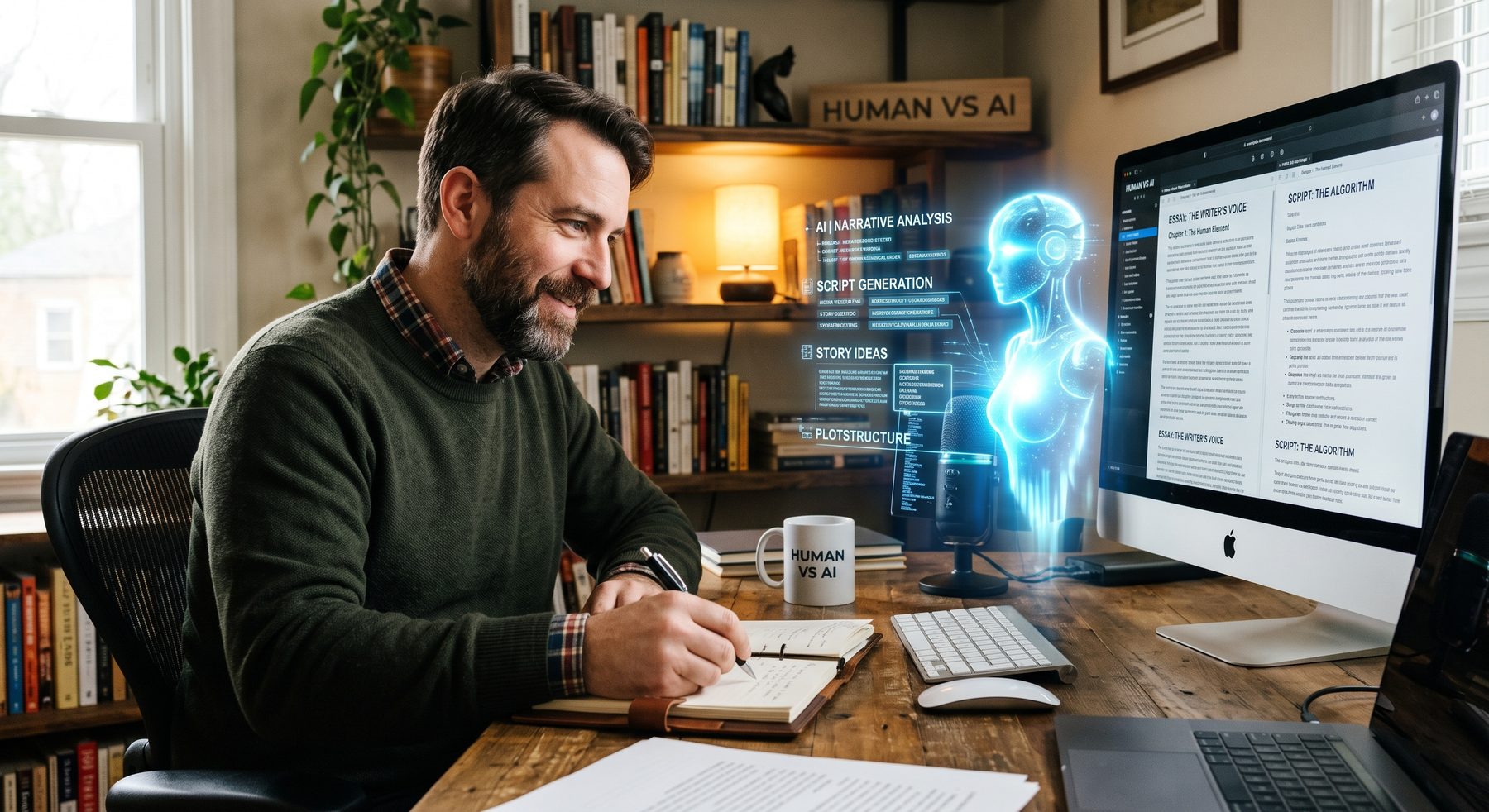
The four-second draft
Watch someone use an AI writing tool for the first time and the reaction is always the same. A keyword goes in. Four seconds later a thousand words come out, with headings, a conclusion and a passable sense of rhythm. It looks like writing. For about thirty seconds, it feels like magic.
Then the person reads it properly. And the sentence that lands is almost never "this is better than I could do." It is "this is fine, but it isn't mine."
That gap, between output and authorship, is what this piece is about. Not whether AI can write. It can. The question is what is left for a person to do, and why that residue turns out to be the part that actually matters.
What these tools are genuinely good at
It is worth being precise, because the argument for human writing gets weaker when it rests on dismissing the technology. AI writing tools are good at real things.
- Getting past the blank page. A mediocre first draft you can react to beats an empty document, and the machine produces one instantly.
- Structural scaffolding. Headings, sections, an outline that covers the obvious ground: the mechanical part of planning a piece, done in seconds.
- Consistency at volume. Fifty product descriptions that read like each other, in the same tone and format. Tedious for a person, trivial for a model.
- Compression and reformatting. Turning a long interview into bullets, a bullet list into prose, a paragraph into a meta description.
- Research triage. Gathering the broad shape of a topic fast enough that you know which questions are worth asking.
What they cannot do
Now the other column. These are not soft complaints about quality. They are structural.
They have no experience to draw on
A model has read about everything and lived through nothing. It knows how grief is usually described. It does not know the specific weight of a particular afternoon. That sounds sentimental until you try to write something a reader remembers, at which point it becomes the whole game.
They converge on the average
Ask for a headline about a product launch and you get the median headline. Ask a hundred times and you get a hundred versions of the same idea, because the model predicts what is most likely, and what is most likely is what has already been said. Originality is by definition the improbable choice. A system built to pick the probable will avoid it.
They cannot be accountable
If a generated article contains a claim that is wrong, nobody's judgement produced it and nobody's name is on it. Writing carries responsibility. A model cannot carry anything.
They cannot want anything
The best writing has a point of view, and a point of view comes from caring about the answer. A model has no stake in whether you agree. That is why it can produce a competent argument for either side of any question and never feel the discomfort of being wrong.
To create a novel or a painting, an artist makes choices that are fundamentally alien to artificial intelligence.
— Ted Chiang, "Why A.I. Isn't Going to Make Art", The New Yorker, 2024
The gravity of the average
There is a mechanical reason AI-generated content tends to feel samey, and it is worth understanding, because it explains why "good enough" is a trap.
Language models are trained to predict likely text. That makes them extraordinary at fluency and poor at surprise. The writer Ted Chiang put it better than anyone: a model is a lossy compression of everything already written. What comes back out is the shape of the average, with the specifics smeared away.
Ted Chiang described ChatGPT as "a blurry JPEG of the web" — a lossy copy that preserves the gist and discards the detail.
When thousands of publishers use the same handful of models to cover the same topics, the output pulls toward a common centre. The web fills up with competent, indistinguishable material, and readers notice. The dictionaries noticed too.
Merriam-Webster made "slop" its 2025 Word of the Year, defining it as "digital content of low quality that is produced usually in quantity by means of artificial intelligence." In the 1700s the word meant soft mud; by the 1800s it meant food waste fed to pigs.
Source: Merriam-Webster
The word sends a little message to AI: when it comes to replacing human creativity, sometimes you don't seem too superintelligent.
— Merriam-Webster, explaining its choice of "slop" as 2025 Word of the Year
For a business that is a slow-motion problem. You spend money to sound like everyone else. For a reader it is worse, because the reason to read a specific person is that they noticed something you would not have.
A machine can tell you what is usually said. It cannot tell you what only you have seen.
Even the machines cannot tell
Here is a detail that should puncture some of the confidence around all this. The tools built to detect AI writing turn out to be mostly measuring predictability, which means they mistake plain, unadorned human writing for machine output.
A Stanford-led study of seven widely used AI detectors found they misclassified more than half of human-written TOEFL essays as AI-generated — an average false-positive rate of 61.3%. At least one detector flagged 97.8% of those human essays as machine-written, while the same detectors scored native-English student essays almost perfectly. Rewriting the essays with richer vocabulary cut the false-positive rate to 11.6%.
Source: Liang et al., "GPT detectors are biased against non-native English writers" (2023)
Read that again, because the implication is uncomfortable. The detectors were not identifying machine writing. They were identifying writing that was predictable — and rewarding linguistic flourish as proof of humanity. If your prose is clear, direct and plain, it is more likely to be flagged. The humans being punished were disproportionately the ones writing in a second language.
The lesson is not that detection is useless. It is that "does this read like a machine wrote it?" is not a quality test. Fluency was never the thing worth measuring.
Why specificity is the moat
Strip away the technology and publishing has always rewarded the same thing: something that could only have come from here.
The reviewer who used the tool for six months and found the bug nobody mentions. The grower who explains why the yield figures look good and the soil does not. The engineer who admits the architecture choice was wrong. None of that can be generated, because none of it is in the training data. It happened to one person, once.
This is not an argument against efficiency. It is an argument about where to spend the human hours. If a machine can produce the scaffolding, the person should be spending their time on the parts the machine cannot reach: the observation, the judgement, the sentence that could only have been written by someone who was there.
A workflow that keeps the human in charge
The teams getting this right tend to converge on the same division of labour.
- A person decides what the piece is for and what it argues. This part cannot be delegated, because it requires wanting something.
- The machine produces the scaffolding: outline, structure, the obvious sections, in minutes.
- A person does the reporting, testing and observing. This is where the value is created and it cannot be skipped.
- A person writes the parts that carry the argument and the evidence, in their own words.
- The machine handles the mechanical edges: meta descriptions, variants, formatting, trimming.
- A person reads the whole thing once more and takes responsibility for it. That last step is what makes it published work rather than generated text.
Notice where the machine sits: in the middle. It accelerates the parts that were always drudgery. It does not touch the parts that earn a reader's attention.
The uncomfortable part
It would be dishonest to pretend this is cost-free. AI writing is dramatically cheaper, and the flood is already visible in places where volume beats quality.
In September 2023 Amazon capped self-publishing at three books per day, after an influx of AI-generated titles onto its store.
Source: The Guardian
Spotify said it removed more than 75 million AI-generated "spammy tracks" from its service and introduced policies to protect artists from impersonation.
Source: CNBC (December 2025)
A publisher who replaces three writers with a model will save money next quarter. That pressure is real and it is not going away, and anyone arguing for human writing has to answer it rather than ignore it.
The answer is not that human writing is morally superior. It is that the cheap version is a commodity, and commodities compete on price until the price reaches zero. If your content is indistinguishable from what a model produces, you are in a race to the bottom against a competitor who never sleeps.
The escape is the opposite of the instinct. Do less, better, and make it unmistakably yours. One piece that could only have come from you is worth more than twenty that could have come from anyone, including a machine.
What we take from this
We use AI tools on this site. We use them to research, to structure, to draft and to check our own work. We would be foolish not to, because they are good at the parts of publishing that were always tedious.
But every review here still carries a judgement, and a judgement is something a person has to make. A model can tell you what a pricing page says. It cannot tell you whether the tool is worth your money, because it has never spent any.
The machine is in the room now and it is staying. The mistake would be to let it take the seat that matters.
The author is still the author
Writing was never really about producing text. It was about noticing something, deciding it mattered, and finding a way to make someone else see it. Text is only the delivery mechanism.
AI has made the delivery mechanism nearly free. That does not make the noticing worthless. It makes it the only thing left that is worth anything.
Sources and further reading
- Ted Chiang, "Why A.I. Isn't Going to Make Art", The New Yorker (2024)
- Ted Chiang, "ChatGPT Is a Blurry JPEG of the Web", The New Yorker (2023)
- Liang et al., "GPT detectors are biased against non-native English writers", Patterns / Stanford HAI (2023)
- Merriam-Webster, Word of the Year 2025: "slop"
- The Guardian, "Amazon restricts authors from self-publishing more than three books a day after AI concerns" (2023)
- CNBC, "Merriam-Webster declares 'slop' its word of the year in nod to growth of AI" (2025)
We use AI tools in our research and drafting on this site. Every judgement and every recommendation is a person's.