The AI Singer Who Performed a Grief He Never Had
River Cain has five singles climbing charts that most real artists would kill for, and no mother to grieve for. The fake country star's darkest move is not the fake music. It is the fake tragedy — the phone thrown at his face, the woman crying for her dead son, the sick mother by the bedside — all of it invented so that strangers would feel something and share the clip.
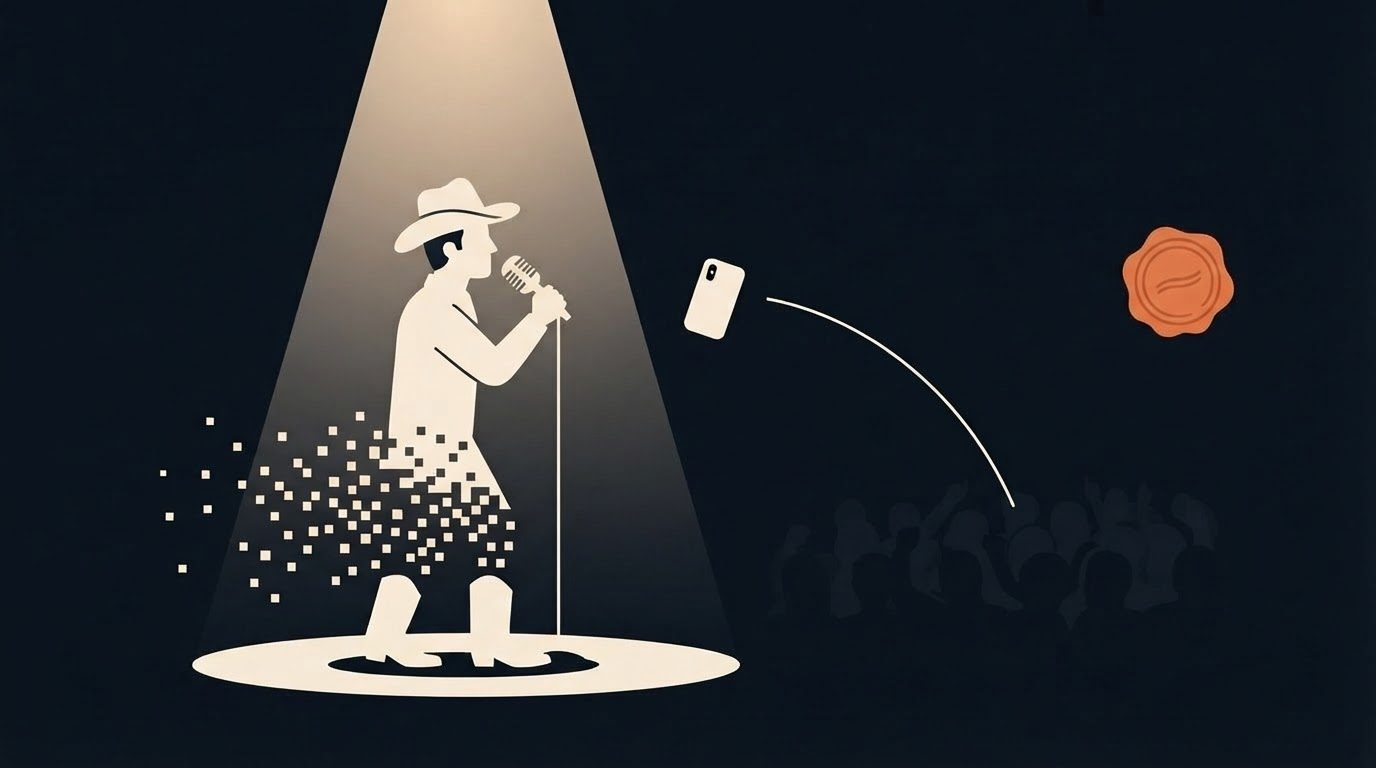
A video went around last month that would have been strange even before everything got weirder. A country singer walks to the front of a small stage. Someone in the dark throws a phone and it cracks him in the face. He stumbles, recovers, keeps singing. It is the oldest currency of live music, the unscripted “did you see that” moment — the clip that travels because it plainly was not planned.
This one was planned. The singer is an AI persona called River Cain. He does not exist. He was not on a stage, and no phone was thrown. The version of the story that made the clip spread — that the crowd turned hostile because he sang a song about Jesus — was written down in advance by whoever builds him. None of it happened, and all of it worked.
A few years ago it would have been enough to say the artist is fake and stop. It is not enough anymore, because the fake is no longer the story; the manufactured life around it is. For as long as there has been popular music, a large part of what a star sold was not the songs but the person singing them — the beefs, the losses, the redemption arc that made strangers feel they knew someone. River Cain's creators understood the next step. If the performer is already a fiction, why not invent the biography too, especially the parts of it that make people feel something?
God first. Country music artist. AI persona.
— River Cain's own biography, via Saving Country Music, 27 September 2026
That confession is sitting in his bio — or it would be, if anyone read it. The bluntness is almost part of the trick. He has said, in the one place a careful person would look, exactly what he is. The audience he is performing for almost never looks there.
The numbers look like a real career
By August, River Cain had five singles on the iTunes chart, with “Hell Out of Me” at number three and “Mama's Boy” at number four, plus an album at 55 and another on the way. The music had been released back in December or in April — the reports are not consistent — but had suddenly begun to climb. Ten or twelve videos sat under his name on YouTube, and more on Instagram, shot as though he had appeared on singing competitions. He was, as the industry chronicler Roger Friedman put it, gaming the platforms, and doing it well enough that the songs held real chart positions.
By 16 August 2026, AI country singer River Cain had five singles on the iTunes chart, including “Hell Out of Me” at number 3 and “Mama's Boy” at number 4, along with an album at number 55 and another scheduled for 4 September.
He is not the first fake artist to reach a chart, and it is worth being honest that the songs themselves are not the scandal. The tools are good enough now that AI can make a passable country track; several of these do exactly what the genre requires. The scandal is the part of the career that used to be impossible to fake.
The drama used to cost a person something
Here is the shift that matters. A real artist who manufactures a feud or a tearful moment is taking a risk, because there is a real person who has to live with the consequences — the reputation, the embarrassed correction, the fans who feel lied to. The lie is expensive because the liar is human. An AI persona pays none of those costs. It has no reputation to lose, no fans to disappoint, no biography that can be contradicted, because the biography is what is being made up in the first place. So the maker can escalate without limit.
Saving Country Music tracked the escalation across September. The first staged clip, on the 2nd, showed the phone hitting him in the face. The second, posted on the 18th, went further — the very same phone, but now thrown because he had dared to praise Jesus, which wired a fake outrage into the fake moment and made it travel. Then the videos stopped being about conflict and started being about grief.
One shows a mother crying over the loss of her son, called up from the stage by River Cain. Another shows a woman holding a similar sign, a husband this time instead of a son. There is a video of him holding his mother's hand by her hospital bedside, and later buying her a house with his music earnings. Read what is actually being claimed. A performer who does not exist is being presented as the comfort to a real woman who may be an actor, a paid extra, or a stock clip — and the son she is grieving may not exist either. Grief is being performed, at scale, by a program, to make you share a video.
Another Day Old — something he will never be.
— Showbiz411, on "Eddie Dalton," an earlier AI blues persona, March 2026
Before River Cain there was Eddie Dalton, an AI-created blues singer presented as a seventy-year-old man, whose three songs reached the iTunes top 100 — selling 13,000 copies and collecting 525,000 streams in a single week — from a label that appeared to run a whole line of invented artists.
A comedically precise way to put it, and the lineage is real. Before River Cain there was Eddie Dalton, a fake blues singer presented as a seventy-year-old man — whose numbers were striking enough that almost no one, Friedman noted, realised the whole thing was a fabrication. River Cain is what that first experiment grows into once its makers notice that a sad story attracts more engagement than a merely impressive one.
Nobody told the audience
The requirement for all of it to work is that the audience does not know. On a few videos, community notes appear, flagging the clip as AI-generated. On many they do not — and even where they do, most people are sharing the emotion, not reading the correction. The comment sections read as though a real singer had been attacked by a real crowd. People rarely click through to the profile that says, plainly, AI persona; they engage with the video. That is the entire arrangement in one sentence. The disclosure is present, and it is useless, because the thing being consumed is the moment, not the identity.
The platform's own answer to this arrived a couple of months ago and is worth being fair about, because it is the most serious tool anyone has proposed. Spotify now flags AI personas with a badge and keeps them out of recommendations by default.
Listeners have been clear in telling us that they don't like seeing an artist profile that seems human, only to find out that the persona is AI-generated.
— Spotify newsroom, announcing AI Persona labels, 11 August 2026
It is a genuinely good policy, and it is also partly rhetorical, because it depends on disclosure or on Spotify's own review catching a profile. As of the reporting on River Cain, he carried no such badge. The badge catches the artists who admit it or who get noticed; the flood is bigger than the review queue. More to the point, a badge on the profile does not reach the people who never open the profile. The deception happened on the video, and the badge lives on the page underneath it.
The honest counter-argument
It is fair to ask why this deserves alarm. River Cain is transparent in his bio, the work is openly AI, and a person could argue it is harmless — a fictional character, like the act a stage performer puts on, or an elaborate piece of dark satire about how attention works. No one is being legally defrauded, and the disclosure exists for anyone who wants it.
The problem is not the few who read the bio. It is the many who do not, and what happens to everyone else once the pattern spreads. Industry bodies and artists' unions have been pushing to mark AI content so the public is aware; the deeper harm is in the pool of trust that gets poisoned. When an actual performer is hit by an object thrown at a show — which genuinely happens, and is a real and ugly problem in country music this year — the audience now has a prepared response: it is probably manufactured, probably a stunt. And when a real artist loses someone, a certain share of strangers will wonder whether the grief is another campaign. The people who have to pay for River Cain's invented tears are the ones whose tears are real.
That is the part of the current moment that is not satire. Music has always been in the business of manufactured feeling to some degree, and pretending otherwise is naive. What changed is that the feeling no longer needs to be about anything that happened. The stage can be invented, the crowd can be invented, the sorrow can be invented, and there is no person at the centre who could push back or be held accountable. A fiction that performs grief is not connection; it is the most efficient proof yet that there is no one there.
What we take from it
We review AI audio tools, so the practical line is worth stating plainly. The music is not the thing to worry about. These tools can make a song that fits a genre well enough to chart; plenty of the arguments about whether that is good music are beside the point. The thing to watch is the identity and the story bolted onto the output. Every one of these fake-persona operations is selling the same lie the photo and the voice already taught us to look for: that the content is proof of a person behind it.
The useful question to ask of any AI music project is not whether it can make a song. It is whether it needs a real person to exist. River Cain needed a sad biography, so his makers wrote one and acted it out with a phone and a hospital bed. A real artist has the biography already; what they do with the tool is different in kind. The technology did not create the impulse to fake a life — that impulse has always been there. It simply made the fake cheap enough, and consequence-free enough, that nobody in the chain has to feel it.
Which is the whole difference, and the only one left that matters. An AI singer can fake the stage, the thrown phone, the mourning. What it cannot do is be the person the grief is for. That is the one thing it has no training data for, because there is no one home.
Sources and further reading
- Saving Country Music, "New Fake AI Artist River Cain Uses Conflict to Market Itself" (27 September 2026)
- Showbiz411, Roger Friedman, "Country Music Has a New Fake Crossover Pop Star: Fictional 'River Cain,' AI, Suddenly Has Five Hit Singles and an Album on Charts" (16 August 2026)
- Showbiz411, Roger Friedman, "Exclusive: Fake AI Singer Eddie Dalton Has Sold Over 13,000 Records and Had 525K Streams in One Week" (28 March 2026)
- Spotify Newsroom, "Introducing a New Label for AI-Generated Artist Identities on Spotify" (11 August 2026) — primary/official
We use AI tools in our research and drafting on this site. Every judgement and every recommendation is a person's.