The Band That Never Existed Has 1.4 Million Listeners
The music industry has quietly answered the question the rest of us are still arguing about — and its answer is better than a ban.
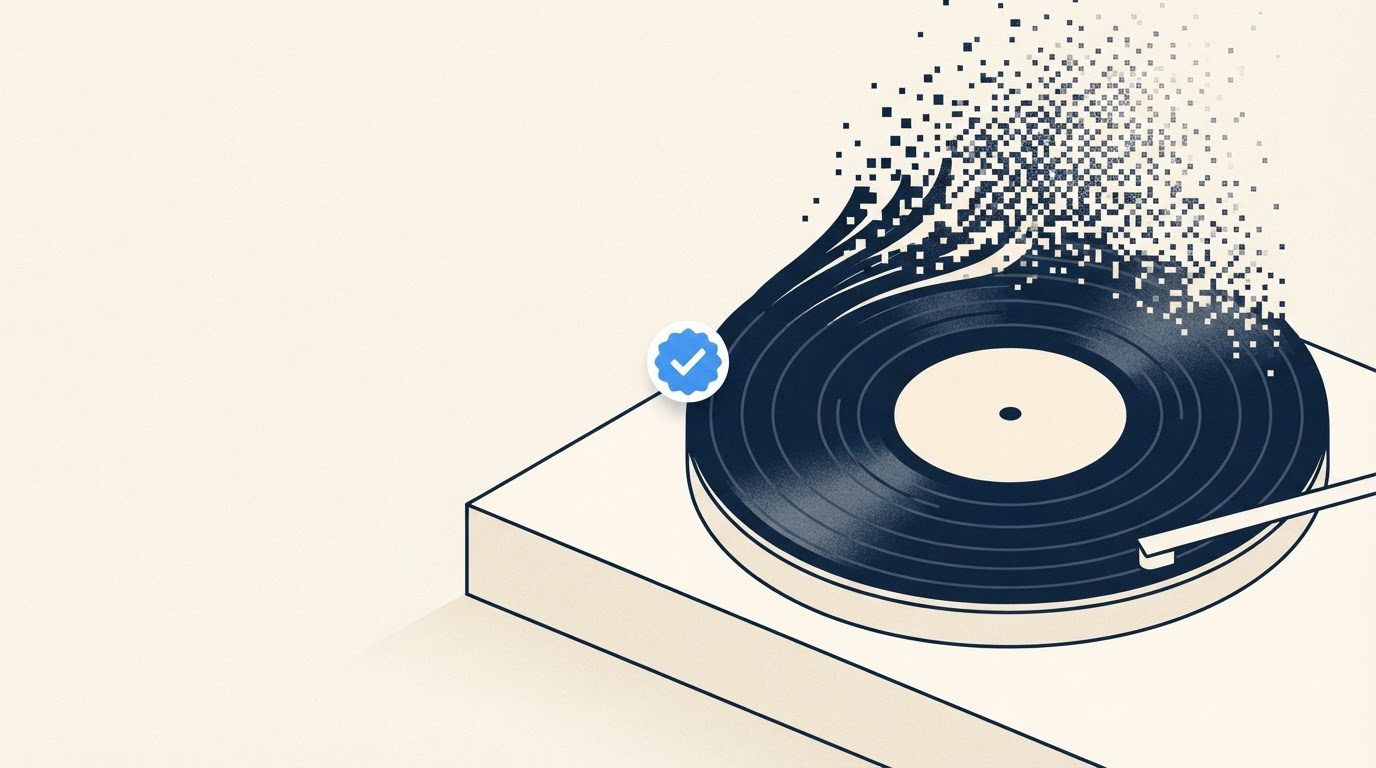
In June 2025 a band called the Velvet Sundown released two albums on Spotify. Within a few months they had three albums, a verified artist account and more than 1.4 million monthly listeners. There was one problem, and it took Reddit about a fortnight to spot it: nobody could find the band.
There were no interviews, no gigs, no photographs that traced back to a real person. The songs kept turning up in the same place real discoveries turn up, which is Discover Weekly. When the band finally addressed it, they did so in the language of a press release written by someone who had recently read a press release.
A synthetic music project guided by human creative direction, and composed, voiced, and visualized with the support of artificial intelligence.
— The Velvet Sundown, confirming their nature on social media
Their earlier phrasing was better. The band had described its members as “not quite human, not quite machine”, which has the ring of a slogan someone will one day put on a t-shirt.
The genuinely funny part came before that. A person using the pseudonym Andrew Frelon set up a fake X account, posed as a spokesperson for the Velvet Sundown, and invented a whole backstory. It fooled a number of outlets, Rolling Stone included. So the story of the fake band briefly featured a fake publicist for the fake band, and the people reporting on the hoax were themselves hoaxed. If you wanted one anecdote to explain 2025 to a future historian, that is a strong candidate.
Then the charts drew a line
Last month the Australian Recording Industry Association stopped being amused. From the week of 25 August 2026, every release must be what ARIA calls “substantially human made” to be eligible for the country's charts.
What triggered it was not the Velvet Sundown. It was a cover of Madonna's Like A Prayer by an Australian DJ, Josh Fawaz, which sat at the top of the ARIA dance singles chart and peaked at number two nationally, collecting more than 48 million Spotify streams on the way. Fawaz added generative AI credits to the release after a backlash, and ARIA then wrote a rule.
The wording of that rule is the interesting part, because it is not a ban on AI. Annabelle Herd, ARIA's chief executive, framed the distinction with unusual clarity.
Artists already use AI tools in their work, the charts can and should evolve to keep room for that, but music generated wholesale by services built on artists' recordings is a different matter.
— Annabelle Herd, chief executive of ARIA
Under the new code, AI assistance is still permitted — but humans must have written the song and performed the lead vocal and primary instruments. AI can still be used for mastering, drum machines and auto-tune. Artists must declare AI use when submitting a song, and ARIA can retrospectively adjust chart positions if a release turns out to have been largely AI-generated.
Source: BBC News, 25 August 2026
Read that list of permitted uses again, because it is broader than the headline “AI banned from charts” suggests. Drum machines, auto-tune, mastering — a great deal of recorded music made since the 1980s would fail a test that ruled those out. What ARIA has actually excluded is the case where nobody wrote the song.
Herd's closing line is the one that will be quoted for years, because it is the honest version of the argument.
A chart that rewards unlicensed AI output would undercut the very basis of the recorded music we exist to represent.
— Annabelle Herd, chief executive of ARIA
Australia is not first. A song was removed from Sweden's charts earlier this year for being AI-created, and in July the International Federation of the Phonographic Industry said AI guidelines would be rolled out for official charts across Latin America, the Middle East, Africa and South-East Asia. The direction of travel is one way.
Spotify has taken the other road
Where ARIA drew a line around what counts as a hit, Spotify has gone after the thing listeners actually complained about, which is being deceived. From mid-September — this month — some artist profiles will carry an AI Persona badge, and those artists are excluded from recommendations by default.
Listeners have been clear in telling us that they don't like seeing an artist profile that seems human, only to find out that the persona is AI-generated.
— Spotify, announcing AI Persona badges, 11 August 2026
“By default, Spotify will not include AI Personas in any editorial or algorithmic recommendations. That means you won't see any music from AI Personas in your personalized recommendations, unless you follow AI Personas, for example.”
Source: Spotify newsroom, 11 August 2026
Two things are worth noting. First, Spotify is not relying on self-disclosure: it says it will also apply badges to profiles that have not declared anything. Second, the penalty is not removal from the platform. You can still publish, and you can still be found. You simply do not get the recommendation slot, which is where almost all of the listeners are. And yes — if you follow an AI persona deliberately, Spotify will still show it to you, which is a fairly elegant way of separating curiosity from being taken in.
Spotify had already removed over 75 million AI-generated “spammy tracks” from its service, alongside policies to protect artists from AI impersonation and deception.
Source: CNBC, December 2025
The song at number 58
Meanwhile the music kept charting anyway, and the most instructive example has nothing to do with a fake band. In June, Fenix Flexin — a rapper known for trap as one half of Shoreline Mafia — released a synth-pop track called Rubberz, sung in a voice that sounds nothing like his. It reached number 58 on the Billboard Hot 100 and picked up more than 35 million Spotify streams.
The Guardian's review of it is one of the better sentences written about AI music this year, entirely because of how unimpressed it is. It reaches for Morrissey, decides it more closely resembles Men at Work's Down Under, and then calls the whole thing “pretty awful”.
We find ourselves asking not “What's the song of the summer?” but rather “Is the song of the summer even real?”
— The Guardian, on the AI music debate, August 2026
That is the sharper problem, and it is not really about quality. A song can be mediocre and still be everywhere. What makes the current moment strange is that a track can now acquire the audience of a hit without acquiring any of the things that used to accompany one — a person, a story, a reason for anyone to care beyond the algorithm surfacing it.
The funniest response came from a real band
Australian electronic act Peking Duk found the ideal way to make the point, which was to take the mickey out of it. They re-recorded their own 2014 hit High with AI, posted it to Instagram, and captioned the result with a line that deserves to be framed.
When you re-record your own song with AI so Australian radio will play it.
— Peking Duk, Instagram caption
Band member Adam Hyde was less playful when asked about it directly, telling Channel Nine's Today show that AI-generated music was “removing the human experience from life”. Both statements are the same argument, and the joke version is the better one.
What this means if you actually use AI audio tools
We review AI audio tools, so it is worth being plain about where this leaves the people using them legitimately — the voiceover work, the background music for a video, the narration for a course.
- The line being drawn is about replacement, not tooling. Every rule described above explicitly keeps room for AI assistance. What it excludes is the version where the human contribution is a prompt and nothing else.
- Declaration is becoming the norm. Artists submitting to Australian charts must declare AI use. If you are producing audio commercially, expect to be asked what you used, and get comfortable answering.
- Distribution is where the penalties land. Spotify is not removing AI personas; it is declining to recommend them, which is where the audience is. Being findable is now a separate thing from being promoted.
- The tools themselves are unaffected. A generated voiceover for a product video, or a produced music bed for a tutorial, is not what any of these policies are aimed at — and it is also not what anyone is arguing about.
If you want the practical version of our audio reviews, the question worth asking about any AI audio tool is the same one the charts are asking: does this replace the person, or does it let the person finish the thing? We have a view on which tools fall into which category, but that is a review, not an essay.
What we take from it
The music business has answered, in about a year and without much agonising, a question the rest of us are still shouting about. The answer is not “ban AI”, and it is not “anything goes”. It is: declare it, keep the human at the parts that matter, and stop promoting the version that has nobody behind it.
That is a more useful position than either extreme, and it arrived from the industry that had the most to lose from getting it wrong. ARIA's rule allows drum machines, auto-tune and mastering while insisting a human wrote and sang the song. Spotify's badge does not remove anything; it just refuses to pretend.
The awkward part is that both policies are easier to write than to enforce. ARIA is relying on self-declaration plus retrospective adjustment, which is a polite way of saying “we will deal with it if someone tells us”. Spotify's badge will catch the profiles that self-disclose, and the ones that get noticed, and it will miss everything else. Neither is a solved problem.
But the direction is now set, and it points at the same thing the rest of this site keeps arriving at. The tooling is not the problem. The absence of a person is the problem. You can assemble a record without one, and people will listen for a while — they just will not care, and they will not come back. That was true before generative AI and it is going to stay true after it.
Sources and further reading
- Spotify newsroom, “Introducing a New Label for AI-Generated Artist Identities on Spotify” (11 August 2026)
- BBC News, “Songs created by AI banned from Australia's music charts” (25 August 2026)
- The Guardian, “‘I feel like I'm at war’: are we losing the battle against machine-made music?” (13 August 2026)
- Berklee, “The Velvet Sundown: The AI Band Controversy Explained” (22 July 2025)
- CNBC, Spotify removed over 75 million AI-generated “spammy tracks” (December 2025)
- pikowise: AI audio tools reviewed
We use AI tools in our research and drafting on this site. Every judgement and every recommendation is a person's.