The Photograph Turns 200 Years Old. It Just Stopped Being Proof.
2026 is photography's bicentenary and the year a fake passed as a news photo while an authentic photo was dismissed as fake in the same breath. A photograph no longer proves anything on its own; trust has moved to the chain of custody around it.
The first week of the year brought a photograph that was not a photograph. On 3 January 2026, American forces captured the president of Venezuela, Nicolás Maduro, and within days an image was moving through social media: Maduro in a white shirt and dark jacket, escorted away from an aircraft by two United States law-enforcement agents. Established outlets and experienced journalists shared it. Reuters fact-checked it and found that Google's SynthID detector judged it to have been generated or edited with artificial intelligence. Verified footage of the real moment showed Maduro arriving in a light blue hooded sweatshirt and handcuffs. The arrest happened. The picture of it did not.
2026 began with a fake image.
This is the year photography turns 200, and it is the year a photograph stopped being able to prove anything on its own. That is not a complaint about image quality. It is a change in what the medium is, and it deserves to be understood before anyone decides what AI image tools are for.
Be honest about what the tools are good at
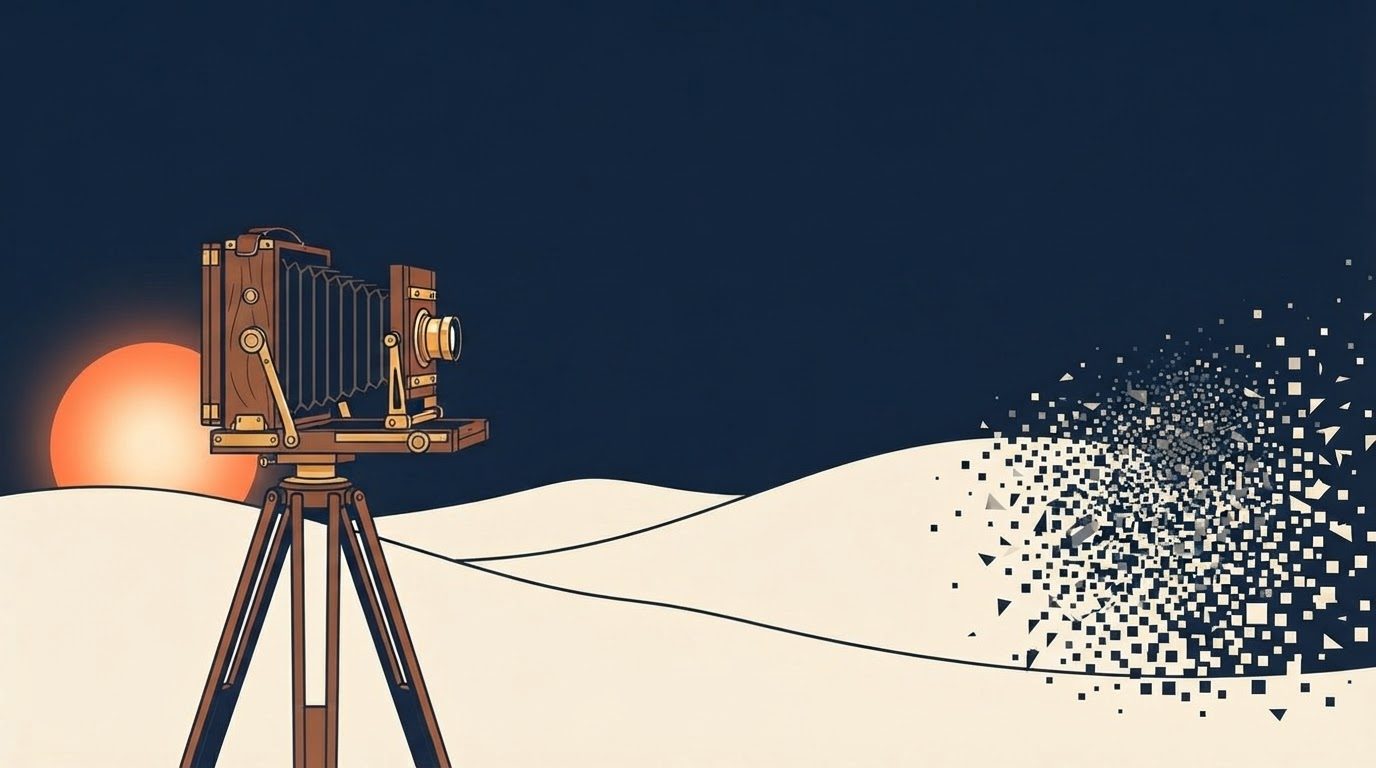
It would be wrong to pretend AI image tools are worthless. They are genuinely useful. A designer needs a mood board, a studio needs concept art, an article needs a hero image, and a model can produce a plausible picture of almost anything in seconds. We use them on this site; the illustration at the top of this essay was generated. That is not hypocrisy—it is the point of the technology, and it works.
The trouble is what the same capability takes away. For two centuries a photograph had a special status in the world, and not because it was pretty. It was evidence. People could disagree about what a scene meant, but not about whether a scene had been there, because a photograph was the record of light that had actually fallen on a surface. That assumption is now gone, and it cannot be rebuilt by looking harder at pixels.
The sun stopped drawing
There is a reason the earliest photographer chose the word he did. Joseph Nicéphore Niépce made the first surviving photograph, View from the Window at Le Gras, in either 1826 or 1827—nobody knows the exact date—by exposing a sheet of pewter coated in a light-sensitive resin for some eight hours in a camera obscura. He called his process heliography. In Greek it means sun-drawing.
The first photograph, View from the Window at Le Gras by Nicéphore Niépce, is returning to France in 2026 for the bicentenary of photography after 200 years away. An eight-hour exposure on a pewter plate coated with bitumen of Judea, taken through a camera obscura, it is now part of the Gernsheim Collection at the Harry Ransom Center in Texas.
The word matters. A photograph was, literally, written by the sun. Light struck a surface and left a physical mark, and that mark was the reason a photograph could stand in for a fact. It had touched what it showed.
A generated image is the opposite of that in every particular. There is no light source, no surface, no eight-hour silence, no moment. A model has been trained on millions of pictures and now guesses which arrangement of pixels would probably look like a scene. The format is identical and the referent is absent. It never had to be real, and that is the whole difference. A photograph's authority used to live in the process that made it; a generated image's process guarantees nothing.
Detection is not the answer, and here is the uncomfortable reason
The obvious fix is a better machine that tells fakes from photographs. But detectors run into a problem that no amount of engineering closes: the accusation works in both directions. Once a fake is possible, calling something fake becomes a usable move against something real.
David Carson, a photojournalist who spent 24 years on the staff of the St. Louis Post-Dispatch and then studied this question as a John S. Knight Fellow at Stanford, documented exactly that in the 2024 American election. Donald Trump accused his opponent of using generative AI to inflate the size of a rally crowd. The photographs were authentic. The invention of the fake had made doubt a weapon.
Seeing is no longer believing.
That is the trap. If a detector says a picture is real, the sceptic can still say the detector was fooled. If it says fake, it may be wrong about an authentic, important photograph. Either way, looking at the image cannot settle it, because the question is no longer in the image. It is in the history of the image, and that is exactly where the industry has gone.
Trust moved to the chain of custody
Instead of trying to see through the medium, the camera industry and the major platforms decided to stop depending on the picture alone. They built a record around the making of the picture. The result is Content Credentials, the open standard run by the Coalition for Content Provenance and Authenticity (C2PA), now backed by more than 500 companies, Adobe and Microsoft and Google and Meta and OpenAI among them.
Almost anyone can create realistic photos, videos, audio files, and documents with easy-to-use tools and a few clicks.
— Content Credentials / Coalition for Content Provenance and Authenticity (C2PA)
The mechanism is a small digital pin on an image that carries verifiable information about how it was made: what produced it, when, and what was edited afterward. Cameras are beginning to sign photographs at the moment of exposure, so a news picture can carry a cryptographic chain back to the sensor and the person holding it. The claim is not “trust this picture.” It is “here is a record of who made this that you can check, and the picture did not survive that chain of custody intact.” That is a different and more honest thing to ask of an image.
It is also, not coincidentally, how the legal system has treated photographs all along. A photograph was never, by itself, admissible as proof of what a scene showed. What mattered was the chain of custody: who took it, when, on what device, and whether anyone had touched it. C2PA simply brings that old discipline to digital pixels, before the fact, instead of after a dispute.
What this means if you use AI image tools
We review AI image tools, so we have a stake in where this lands, and we have a plain view to offer. A picture's value to you, your brand or your publication is no longer proportional to how convincing it looks. It is proportional to whether anyone can verify where it came from. For concept art and illustration, that is fine—nobody needs provenance for a mood board, and the tools are excellent for it. For anything that asserts a fact about the world—a product, a location, an event, a person—the question has changed from “does it look real?” to “can the record of its making be trusted?”
We should also admit the limits, because they are real. A chain of custody can itself be forged, and the human in the chain can lie. Most casual images will never carry a pin. And a generated illustration passed off as a photograph is still a lie, provenance or not. None of this makes the standard useless. It makes it incomplete, which is different from wrong, and it is the best answer anyone has.
Two hundred years ago a photograph was proof because the sun had drawn it. This year it stopped being proof, because a model can draw one that never happened. The way out was never a cleverer pair of eyes. It is a chain you can check, which is the same answer courts arrived at long before computers existed.
The photograph turns 200 this year, and it has lost its automatic word. That is not the end of the medium. It is the return of an older idea: that an image means what the process behind it can vouch for. The picture no longer stands alone. The record around it does.
Sources and further reading
- Reuters Fact Check, “Photo of Maduro in black jacket among uniformed personnel is AI-generated” (6 January 2026)
- RFI, “AI challenges trust in photography as Visa pour l'Image festival opens” (29 August 2026)
- Digital Camera World, “The first-ever photograph is returning home to France for first time in 200 years” (7 September 2026)
- Content Credentials / Coalition for Content Provenance and Authenticity (C2PA)
- John S. Knight Journalism Fellowships, Stanford, David Carson, “Seeing is no longer believing” (2024)
We use AI tools in our research and drafting on this site. Every judgement and every recommendation is a person's.