The Slop Economy: The New Gig Economy Job Is Cleaning Up AI's Mistakes
A whole freelance economy has quietly grown up around fixing what AI produced. It is real income now, and the clients paying for it may have just bought the most expensive version of the mistake they made first.
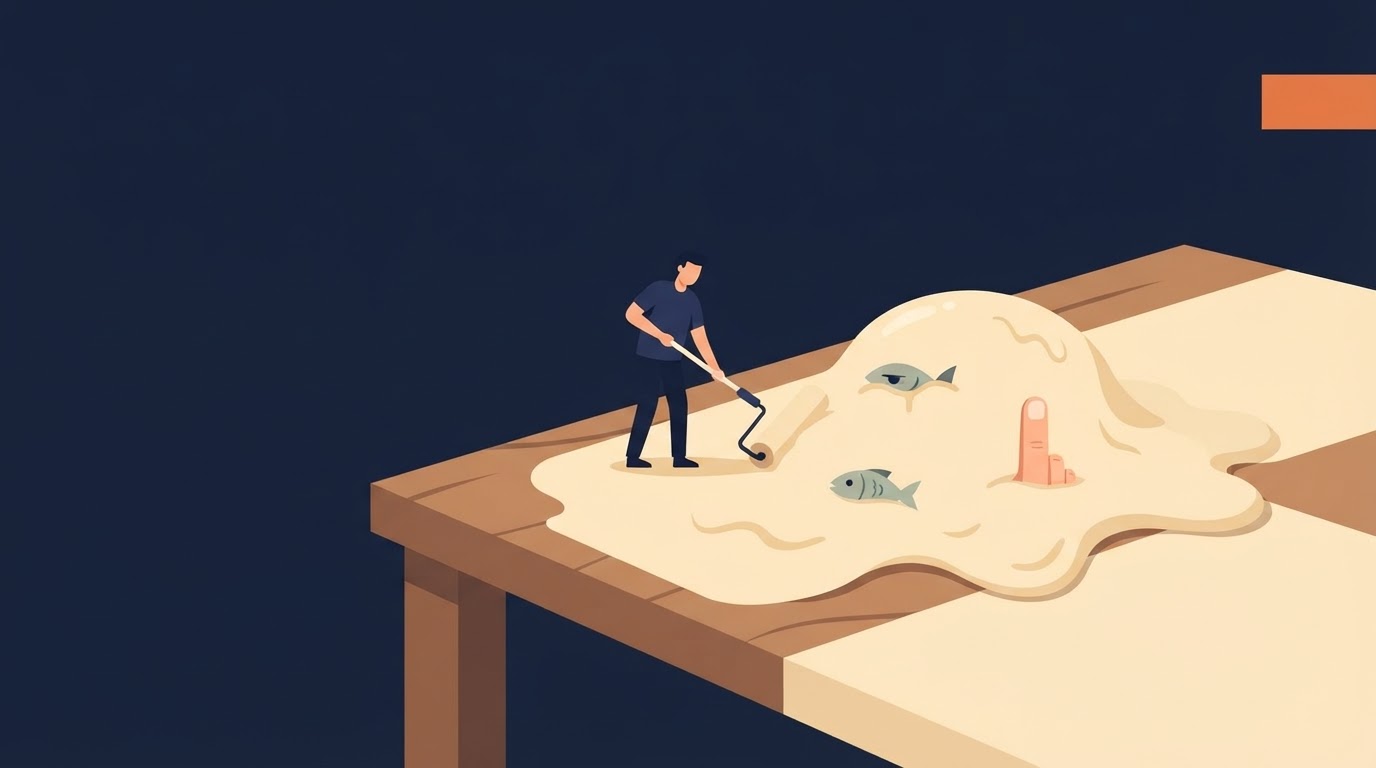
A graphic designer in Spain used to get one-off jobs drawing logos and packaging. By 2025, 90% of her incoming requests were different: fix this. Sharpen this fuzzy image for print. Turn this broken design into a usable file. The requests were for work a machine had already done badly, and the fixing accounted for 60% to 70% of her annual income, until she stopped taking them.
It was just so soulless.
— Lisa, a freelance graphic designer in Spain, on the AI cleanup work she now refuses
She is not an outlier. She is a job category. Somewhere between 2023 and now, a freelance economy grew up around the second half of an AI workflow: the part where the first pass comes back with extra fingers, melting physics, and a watermark it cannot remove. The work has a name, it has platforms, and it now has numbers.
The numbers, for once, are boring and useful
The platforms that host this work have counted it. On Freelancer.com, a site with more than 88 million users, job listings tagged with phrases like "correct AI", "AI hallucination" and "AI error" rose 87% to 10,760 globally between August 2025 and June 2026, according to internal data the site shared with the Guardian. The jobs concentrated in graphic design, then video editing, proofreading and content writing. Upwork saw AI remediation gigs jump 70% year on year, and Fiverr reported that searches for "AI cleanup" services grew more than 20 times between 2023 and 2026.
On Freelancer.com, job listings tagged with phrases such as "correct AI", "AI hallucination" and "AI error" rose 87% to 10,760 globally between August 2025 and June 2026; Upwork saw AI remediation gigs jump 70% year on year, and Fiverr saw keyword searches for "AI cleanup" grow more than 20 times between 2023 and 2026.
Source: Freelancer.com, Upwork and Fiverr data, via The Guardian (2 September 2026)
The scale of what the cleanup crews are trying to fix is also starting to show up in advertising data. DoubleVerify, the ad verification company, detected more than half a billion impressions of low-quality AI-generated content in the first half of 2026 alone. And the slop is not confined to a few shame corners of the internet: the company recently uncovered a coordinated network of more than 200 AI slop domains in which the operators, for reasons nobody quite explained, left the AI prompts used to build the sites sitting in the code.
DoubleVerify detected more than half a billion impressions of low-quality AI-generated content in the first half of 2026, and nearly half (48%) of UK consumers say seeing a brand advertised alongside low-quality AI content would negatively impact their perception of that brand — including 30% who say it would have a very negative impact.
Source: DoubleVerify, via Advanced Television (14 September 2026)
AI slop isn't limited to a handful of websites or isolated corners of the internet. It's appearing on a broad and growing range of content, with new sources emerging every day.
— Nayef Hijazi, VP of Solutions and Content Marketing at DoubleVerify
A day in the cleanup trenches
The funny part of the job is what is actually being fixed. A full-time illustrator in Florida spends his time filtering out visual noise, improving resolution, and hunting for "an extra toe". A multimedia editor has spent two to three hours per image repairing roughly 100 AI-generated pictures of humanoid animals for a tarot deck, riddled with extra fingers, two left feet, and other mistakes — before he called it off.
Another client, in the same Guardian piece, offered about $500 to repair 13 to 15 AI-generated illustrations for a children's book, with the expectation that each should take about 15 minutes. The illustrator turned it down. His rate is $65 an hour, he said, and "doesn't go down from there". Clients, it turns out, tend to price the second pass of a job as though the first pass was free, and sometimes better.
A freelance writer in Australia now spends about 60% of her workload on cleanup, and has worked on around 40 AI-generated nonfiction books, longform articles and technical papers since stumbling into the work in 2024. She describes it as interesting and challenging, then says the thing nobody in the industry wants to say out loud.
I just feel it's a shame we need to do it.
— Kym Dunbar, freelance writer and editor in Australia, on AI cleanup work
That sentence carries the whole story. The cleanup work is not a symptom of AI being good enough to use and bad enough to need fixing. It is evidence that the first pass was never the product. The product is the thing a person makes of it. The machine produced a draft the way a bad intern used to, except the draft now arrives in volume, and the intern has no sense of when to stop.
Even the platforms have given up on the disguise
The strangest development in the slop economy is how openly the platforms are now fighting it. In August, LinkedIn rolled out a "Seems like AI Slop" button, and in the first two weeks more than one million members used it. The company says the feedback has already helped reduce views of content classified as AI slop by 40%, that it is catching hundreds of thousands of automated comment attempts every day, and that it has blocked billions of pieces of automated activity in recent months. It is also quietly replacing its "enhance your post" feature with tools that proofread without changing the writer's voice, which is the first time a major platform has drawn the line between AI assistance and AI replacement on its own interface.
Within the first two weeks of launching its "Seems Like AI Slop" button in August, more than one million LinkedIn members used it, and the company says recent efforts have reduced views of content classified as AI slop by 40%. LinkedIn is also blocking hundreds of thousands of automated comment attempts every day.
These initiatives are reinforcing our commitment to keeping LinkedIn a place for real people, real expertise, and real perspectives.
— LinkedIn newsroom, on its anti-slop programme
Read that phrase again: real people, real expertise, real perspectives. A professional network that has made a product decision on the basis that a post's credibility is damaged when it cannot be trusted to come from a person is, in practice, running a business that sells exactly what the cleanup freelancers have known for two years: the default output of a model is not good enough for anyone's name to be on it.
A London studio built a monster on purpose
The best response to the whole thing came from somewhere nobody expected: an art fair. Electric Dreama Studios, a small London outfit led by creative director Sam Nutt, presented a sculpture called CH(AI)MERA at the British Art Fair at the Saatchi Gallery this week. It is a grotesque amalgamation of AI slop body parts, with poreless skin that looks like it is melting and uncanny dead eyes, deliberately built as the ugliest version of AI output the studio could produce.
The reason, per the studio's own account, is the one that makes it a joke about the entire industry rather than a piece of it: the monster is a vow. Everything the studio makes from now on is a commitment to the opposite, with AI "used only as a tool in service of human ideas, and taste always shaping the creation".
We created this piece to hold ourselves accountable. To remind our studio and our clients that we'll never make this kind of slop ever. Everything after this is a promise: only human-first work, where the technology serves the craft, instead of replacing it.
— Sam Nutt, creative director, Electric Dreama Studios
The dictionary had a head start on the studio's naming. Merriam-Webster made "slop" its 2025 Word of the Year, defining it as digital content of low quality produced in quantity by means of artificial intelligence. The word used to mean soft mud, and later food waste fed to pigs. The creative industry has now, in effect, built a museum exhibit out of the etymology.
The part nobody likes to say about the money
Here is the uncomfortable arithmetic. A small company uses a free tool to generate its marketing copy, its product photos and its brand illustrations. The output is bad. It hires a freelancer to fix it, at a rate that assumes the fixing is trivial. The total cost of the finished, usable, on-brand asset is now higher than the cost of commissioning it directly from the start, and the quality is lower, because the freelancer has to spend their hours undoing rather than making.
The Freelancer.com CEO put the mechanism in one sentence: the cleanup work is usually commissioned by small companies and entrepreneurs who used AI to produce a first pass and "run into problems they don't have the expertise to solve". The time and money saved on the first draft, as the Guardian's piece notes, can be eaten up by the "incredibly time-consuming" work of making it commercially usable.
[AI output] needs a human to turn it into something polished that can actually be used.
— Matt Barrie, CEO of Freelancer.com
That is not a criticism of the freelancers. They are doing exactly what any competent professional would do with a broken brief: fix it, or walk. But it is a criticism of the workflow that produces the brief. The "AI saves us money" line only holds up to the moment the work has to be used somewhere a person's eyes will land on it — a printed package, a client presentation, a chart-eligible release, a post that will sit under a company name forever.
How long does this last
The freelancers themselves are split, which is the honest way to end a piece about a trade nobody planned. Kym Dunbar thinks most of the humanizing work will dry up within five to 10 years as models get good enough to produce usable content on their own. Nathan McConnell, the video editor, disagrees: AI still needs to be "babysat" to catch the mistakes an untrained eye misses, from logos that violate brand guidelines to objects that appear and disappear mid-shot.
The Spanish designer, who now tells clients she no longer works with AI-generated images and occasionally gets the request anyway, has a plan of her own. Some clients "straight up lie" and pass off the images as original, she said, even when the tool's logo is sitting in the bottom corner. And just in case the machines close the gap, she has gone back to the watercolours and physical art she studied before graphic design. Her prediction is that within a year or two, AI will do logo and packaging work as well as she can, leaving "the best of the best" able to make a living. She is not sure she is in that group.
The slop economy is, in one sense, a temporary trade. If the models eventually produce clean output on the first pass, the cleanup crews have no work. In the other, more durable sense, it is permanent: the moment any output has to carry a person's name or a brand's reputation, something human has to stand behind it. The question the trade will answer is which of those two futures is the real one.
What we take from it
We review AI writing and content tools for a living, and this is the most useful signal yet about where the tools actually stand. The tools are good enough that businesses will use them for a first pass, and not good enough that the first pass survives contact with a client, a print shop, a chart, or a reader who notices the extra finger. The gap between those two facts is now a paid occupation, and it is growing.
The practical version, for anyone deciding whether to let a model produce something that will carry their name: the cleanup price is the real price. If the fixing costs more than the making, the making was never cheap. And for the freelancers in the middle of it, the honest summary is the one the Australian writer gave, unprompted, at the end of a long piece about other people's jobs: it is a shame it is needed. That is what a transitional economy sounds like when the people inside it are paid to notice.
Sources and further reading
- The Guardian, "Freelancers are getting buried with 'soulless' AI slop cleanup: 'It's a shame we need to do it'" (2 September 2026)
- DoubleVerify, "Data: AI slop hits 500m+ impressions in H1 2026", via Advanced Television (14 September 2026)
- LinkedIn newsroom, "How LinkedIn is Continuing to Tackle AI Slop" (15 September 2026) — primary
- Creative Bloq, "A creative studio built an 'AI slop monster' sculpture as a promise never to make one again" (20 September 2026)
- Merriam-Webster, Word of the Year 2025: "slop"
We use AI tools in our research and drafting on this site. Every judgement and every recommendation is a person's.