Free vs Paid AI Writing Tools: What You Actually Get
Only one AI writing tool we track has a real free plan. What the free tiers and trials actually allow, where they break down, and when paying starts to pay for itself.
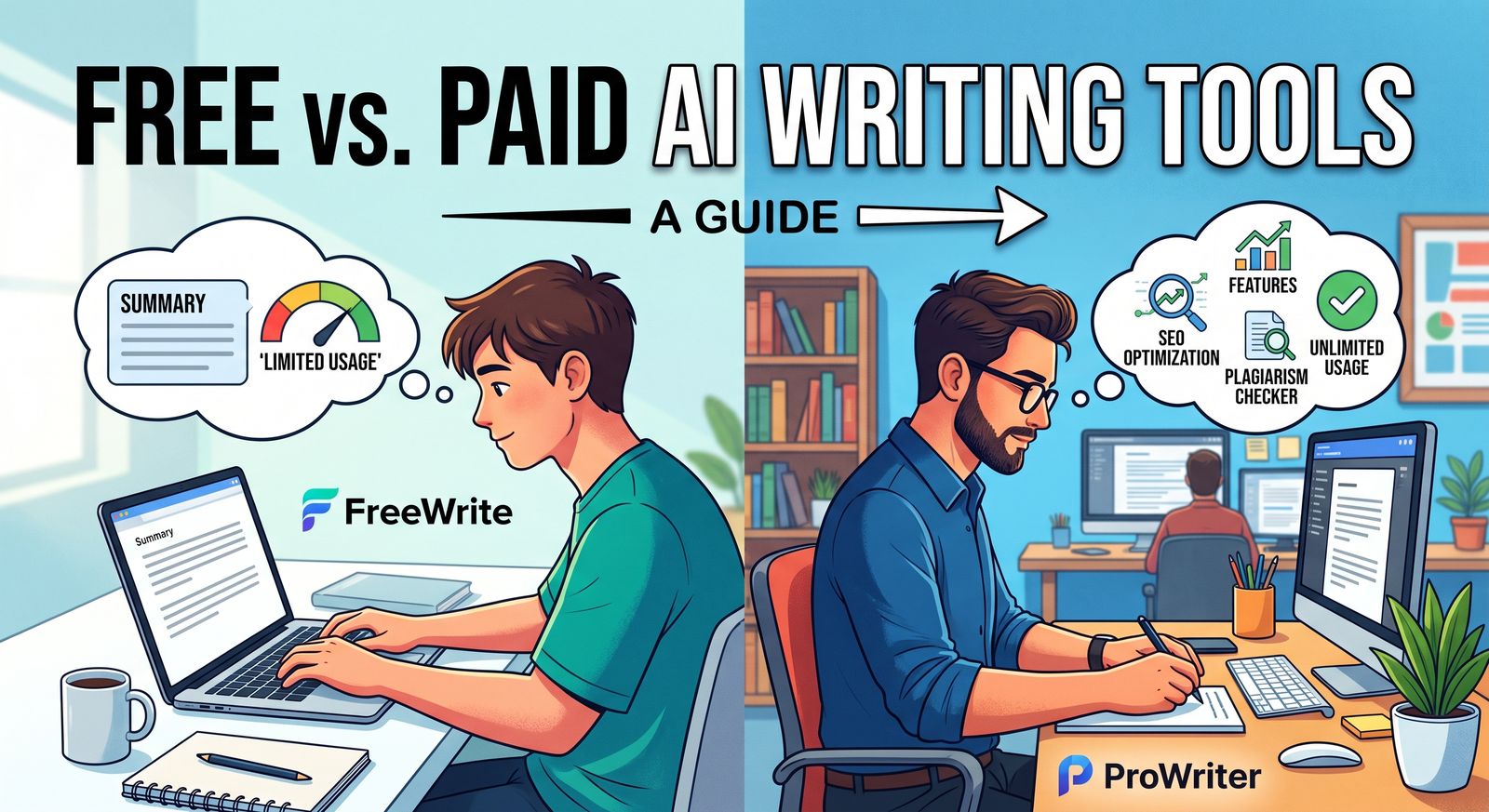
“Free tier” has quietly become a marketing category rather than a description. Most tools in this market do not have a free plan at all — they have a trial, which is a different thing that happens to be free for a week.
The distinction matters more than it sounds. A free tier is a permanent floor you can build a working practice on. A trial is a countdown. Getting them confused is how people end up abandoning a workflow two weeks after switching to it.
Of the eight AI writing tools we track in the writing cluster, exactly one — Rytr — publishes a permanent $0 plan. Everything else offers a time-limited or credit-limited trial instead.
What is actually free
One writing tool we review has a real free plan, and it is worth being precise about what it includes, because the limits are not where you would expect them.
- Rytr, $0. 10,000 characters a month, a single language, and no plagiarism checks. In practice that is a couple of short pieces rather than a content calendar — but it renews every month, forever, which is what makes it a free tier rather than a trial.
- Jasper. A 7-day free trial. Paid plans run $59/mo billed yearly or $69/mo monthly per seat.
- Anyword. A 7-day trial capped at 2,500 words. Paid plans start at $39/mo billed yearly.
- Koala AI. No free plan, but a genuinely useful trial: 5,000 words and 25 credits on signup with no credit card required.
- Writesonic. A free trial that also requires no card, before plans starting at $79/mo billed annually.
- Scalenut. A free trial, with paid plans from $24/mo on a limited 60%-off offer.
- Surfer SEO. Offers a free starting point rather than a permanent free plan; paid plans begin at EUR 49/mo billed yearly.
- Copy.ai. No free tier and no trial listed in our data; paid plans start at $29/mo.
So the honest answer to “which AI writing tools are free?” is: one, for a small monthly allowance. The rest are demos with varying generosity, and two of them — Koala AI and Writesonic — are notable for not asking for a card, which makes them the least risky places to start.
A trial is not a free tier
The difference shows up in three places, and each one catches people out.
- It expires. A trial you build a workflow on leaves you with nothing at the end of the week, and migrating mid-project is worse than never starting.
- It is capped in a way designed to end before you finish. Anyword's 2,500-word trial is a real test only if your brief is short; run a long-form article through it and you will spend the trial learning nothing.
- It changes what you get, not just how much. Free and trial plans often withhold the better models, the SEO scoring, or clean export — the features you actually need for commercial work.
A practical consequence: if you are evaluating tools for a job you do repeatedly, trial them against work you would otherwise do by hand, not against a demo prompt. A trial spent on throwaway text is a week you cannot get back.
Where free plans actually break down
It is almost never just volume. Look at what Rytr's free plan withholds: a single language and no plagiarism checks. Both are the kind of limit that only bites once you are publishing.
- Language. One language is fine until you need a second market.
- Plagiarism checking. Absent on the free plan entirely; you are trusting the model unsupervised. Rytr's $9/mo plan raises this to 50 checks, and $29/mo to 100.
- Tone control. The free plan is one tone, which is the difference between a house style and whatever the model defaults to.
- Credit systems. Some tools meter two things at once — Koala AI's paid plans include both a word allowance and a separate credit allowance — so a free trial can run out on the smaller of the two without warning.
When a plan limits “languages” or “tones” rather than word count, it is limiting your range, not your volume. That is a much harder limit to work around.
What paid actually meters
Before you upgrade, work out which unit you consume, because the plans do not share one. A “word” here is not a “word” there.
- Words. Koala AI starts at $25/mo for 45,000 words a month. Simple to reason about, if you know your output.
- Articles. Writesonic starts at $79/mo annually for 15 articles, 1 user and 10 audits.
- Predictions. Anyword is $49/mo for 50, or $39/mo billed yearly for 100 — a good fit for conversion copy, a poor one for long articles.
- Documents. Surfer SEO is EUR 49/mo yearly for 120 documents and 10 tracked pages.
- Seats. Copy.ai is $29/mo for five seats with unlimited chat words, which inverts the question: you are buying people, not output.
If you cannot say which of those five units you consume in a month, the upgrade decision is premature. Measure a month on free and trial plans first.
What cheap volume produces
There is a reason to be careful about the instinct that free tools are valuable because they let you publish more. The last two years have been a running demonstration of what happens when the cost of producing content falls to almost nothing.
Merriam-Webster made “slop” its 2025 Word of the Year, defining it as “digital content of low quality that is produced usually in quantity by means of artificial intelligence”.
Amazon restricted authors from self-publishing more than three books a day, after an influx of AI-generated titles onto its store.
Source: The Guardian, September 2023
Spotify removed over 75 million AI-generated “spammy tracks” from its service and introduced policies to protect artists from AI impersonation and deception.
Source: CNBC, December 2025
The pattern is consistent. When a platform is flooded with machine-produced volume, the platform responds by capping, purging or penalising it. Search is no exception: Google's spam policies name the case directly, listing “using generative AI tools or other similar tools to generate many pages without adding value for users” as an example of scaled content abuse.
Scaled content abuse is when many pages are generated for the primary purpose of manipulating search rankings and not helping users. This abusive practice is typically focused on creating large amounts of unoriginal content that provides little to no value to users, no matter how it's created.
— Google Search Central, spam policies for Google web search
Which reframes the upgrade decision. You are not buying the ability to publish more; publishing more was never the scarce thing. You are buying time back, better control, and the checks — plagiarism, tone, language — that let you publish something you would put your name on.
When upgrading pays for itself
The threshold is about frequency, not ambition.
- Publishing less than monthly. Stay on trials and free allowances. Rotate between tools as deadlines arrive, and buy a single month when you have a batch of work ready rather than subscribing indefinitely.
- Publishing monthly. One cheap paid plan beats juggling trials. Rytr at $9/mo is the least expensive entry point in the writing cluster and covers unlimited generations.
- Publishing weekly or more. This is where the mid-tier plans earn their place, because the per-article cost falls sharply and the limits stop interrupting you mid-task.
- Publishing for clients. Skip the free question entirely. You need the plagiarism checks, the tone control and the clean export, and you need them on somebody else's deadline.
A useful test: divide the plan price by the number of finished articles you would publish in a month. If that number is smaller than the value of an hour of your time, the plan is already justified. If it is larger, keep using the free allowance.
The cheapest paid plans worth paying for
If you do upgrade, the shallowest jumps are at the bottom of the range — and one correction is worth making, because it is widely repeated: Rytr is the only writing plan we track that starts under $10.
- Rytr, $9/mo. Unlimited generations, one tone, 50 plagiarism checks. The cheapest credible paid plan in the cluster.
- Scalenut, $24/mo on a limited 60%-off offer against a $59 list price, including 10 prompts and 10 GEO articles monthly.
- Koala AI, $25/mo. 45,000 words and 500 credits monthly, and it is the plan we point most long-form writers at.
- Copy.ai, $29/mo for five seats with unlimited chat words — the best value in the cluster for a small team, and the worst if you need long-form articles.
- Anyword, $39/mo billed yearly. Worth it only if you are optimising conversion copy, since it meters predictions rather than words.
Watch the billing terms, not just the price. Anyword does not refund cancelled subscriptions — cancelling stops future renewal only. Jasper allows monthly plans to be cancelled at any time. Those two policies are worth more than a few dollars a month.
What free will never give you
- Verified facts. No plan, at any price, checks that a price is current or a claim is true. That check is your job, and it is the single most common failure on sites that use these tools.
- First-hand knowledge. A free plan and a $400/mo plan will both tell you what is generally true. Neither has used the product.
- A reason for someone to read your page rather than the one above it. That comes from the specific thing you added, and it is the only part of the workflow that no subscription covers.
So use the free tier for what it is good at — finding out whether a tool suits how you work — and treat the upgrade as a decision about time and control rather than a decision about volume. The volume was never the thing that was missing.
Tools referenced in this guide
| Rytr | Koala AI | Writesonic | Jasper | Anyword | Scalenut | Surfer SEO | Copy.ai | |
|---|---|---|---|---|---|---|---|---|
| Type | Budget writer | Long-form SEO writer | SEO article writer | Brand-voice marketing | Performance copy | SEO workflow suite | On-page optimization | Marketing & sales copy |
| From | $9/mo | $25/mo | $79/mo | $59/mo | $39/mo | $24/mo | EUR 49/mo | $24/mo |
| Free tier | Yes | No | No | No | No | No | No | No |
| Visit | Visit | Visit | Visit | Visit | Visit | Visit | Visit |
Frequently asked questions
Are there any genuinely free AI writing tools?
Of the eight we track in the writing cluster, Rytr is the only one with a permanent free plan: 10,000 characters a month, one language, no plagiarism checks, renewing monthly. The rest offer trials. Two of those trials — Koala AI and Writesonic — do not require a credit card, which makes them the safest starting points.
How long are the trials?
Jasper and Anyword both run 7-day trials, and Anyword's is capped at 2,500 words. Koala AI's trial is 5,000 words and 25 credits with no card required. Because the lengths differ, a trial is only a fair comparison if you run the same real brief through each.
What is the difference between a free tier and a trial?
A free tier renews indefinitely, so you can build a practice on it. A trial expires, so you cannot. Confusing the two is how people end up with a workflow that collapses a week after they adopt it.
Is the cheapest paid plan enough?
Usually, for one person publishing up to a few pieces a month. Rytr at $9/mo gives unlimited generations with one tone and 50 plagiarism checks. Upgrade past that when you need multiple tones, more languages, or a word allowance large enough to stop thinking about it.
Does paying more get me better writing?
Not directly. Higher tiers buy volume, seats, tone and language control, and features like SEO scoring. The writing quality differences between credible tools are smaller than the pricing differences, and no plan at any price verifies a fact for you.
When should I switch from free to paid?
When the free allowance interrupts work you have already started, or when you are publishing weekly or more. The test is simple: divide the plan price by the articles you would publish in a month. If that figure is lower than the value of an hour of your time, subscribe.
Sources and further reading
- Merriam-Webster, Word of the Year 2025: “slop”
- The Guardian, “Amazon restricts authors from self-publishing more than three books a day” (2023)
- CNBC, Spotify removed over 75 million AI-generated “spammy tracks” (2025)
- Google Search Central, spam policies for Google web search
- Rytr pricing
- pikowise review: Rytr
We may earn a commission if you buy through links on this page, at no extra cost to you.